
Single vs Double vs Triple Wall: Which Corrugated Board Actually Protects Your Shipment?
Choosing the wrong wall type is one of the costliest, least visible mistakes in packaging. Order single wall when your product needs double, and you're shipping damaged goods and eating return costs. Order triple wall when single would do, and you're overpaying on every single carton, quarter after quarter. Getting this decision right isn't a technical footnote — it's a direct line to your margin and your customer's unboxing experience.
This guide breaks down the real difference between single, double, and triple wall corrugated board, how strength is actually measured, and how to match wall type to your product without guessing.
Not sure which wall type your product needs?
BOSON Tera Pack manufactures corrugating lines that produce single, double, and triple wall board — and our engineers help you match board structure to your actual product weight and shipping conditions.
Request a Free Consultation →Why Wall Type Is the Most Overlooked Packaging Decision
Most buyers focus on box size and print quality, and treat wall type as an afterthought. That's backwards. The wall structure — how many flute layers sit between how many liners — determines whether a box survives a drop, a stack, or a long-haul shipment. A single wall carton and a triple wall crate can look similar on a spec sheet and behave completely differently under load.
Understanding this comparison matters whether you're a packaging buyer choosing between suppliers or an operator planning production capacity around demand for heavier-duty cartons.
Single vs Double vs Triple Wall: The Core Difference
| Attribute | Single Wall | Double Wall | Triple Wall |
|---|---|---|---|
| Layer Structure | 1 flute layer + 2 liners | 2 flute layers + 3 liners | 3 flute layers + 4 liners |
| Typical Flutes | B, C, E, F | BC, EB, AB | AAC, AA-C, CAA |
| Primary Machine | Single facer + glue unit | Single facer (x2) + double backer | Single facer (x3) + heavy-duty double backer |
| Target Application | Standard retail and shipping | Heavy or bulky e-commerce and stacking | Industrial freight, machinery, crate replacement |
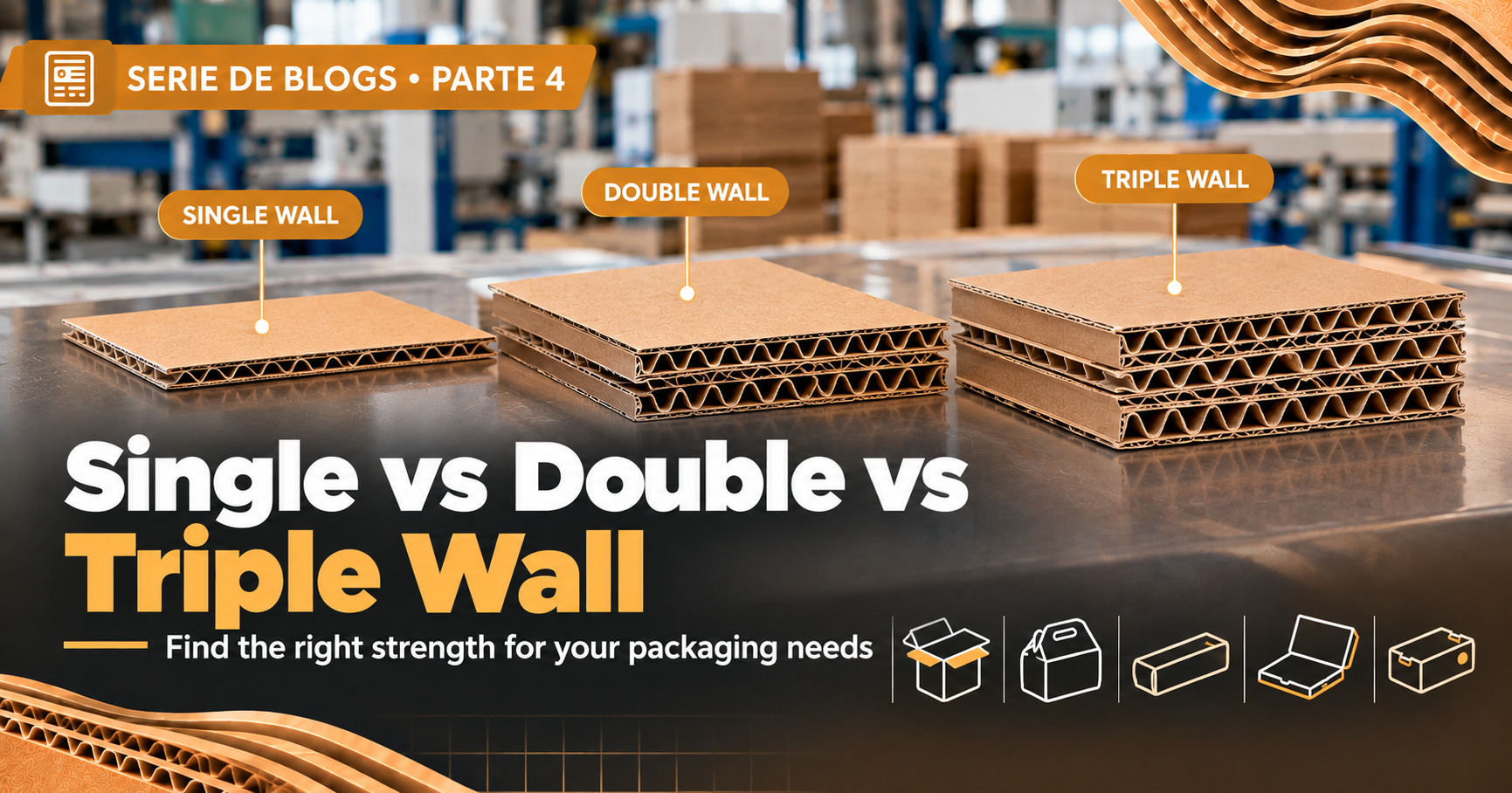
Single wall is one fluting medium glued between an outer liner and an inner liner. It's lightweight, cost-efficient, and handles the vast majority of retail and e-commerce shipping needs.
Double wall adds a second flute layer and a third liner, roughly doubling stacking strength and puncture resistance. It's the standard choice for heavier or bulkier items that need to survive multi-box stacking in a warehouse or truck.
Triple wall stacks three flute layers between four liners, producing a board rigid enough to replace wood crating in many industrial applications — at a fraction of the weight and setup labor.
💡 Pro Tip: Match the Flute, Not Just the Wall Count
A well-chosen single wall B-flute can outperform a poorly matched double wall in specific use cases. Strength ratings — not wall count alone — should drive your final decision. Explore our corrugating lines to understand which flute profiles each machine produces.
How Strength Is Actually Measured
Wall count alone doesn't tell the full story — flute profile and testing standards do too. Three metrics matter most:
- Edge Crush Test (ECT) measures how much force the board's edge can withstand before crushing, which directly predicts stacking strength.
- Mullen Bursting Strength tests resistance to puncture from a single sharp force — critical for irregular or heavy contents.
- Box Compression Test (BCT) evaluates the finished box's overall load-bearing capacity, factoring in flute profile, wall count, and construction.
Higher wall counts generally improve all three metrics, but flute profile selection matters just as much. A well-chosen single wall B-flute can outperform a poorly matched double wall in specific use cases, which is why strength ratings — not wall count alone — should drive your final decision.
Need verified strength ratings for your board?
Our corrugating lines are engineered for consistent flute formation and adhesive bonding — the foundation of reliable ECT and BCT performance. Talk to our engineers about your strength requirements.
Discuss Your Requirements →The Machinery Behind Each Wall Type
Understanding how each board type is produced helps explain why costs and lead times differ so much between wall types.
A corrugating line builds board using a single facer unit, which forms the flute layer and bonds it to the first liner. Single wall board needs only one pass through a single facer. Double wall requires two single facer passes feeding into a double backer, which bonds the additional liners under heat and pressure. Triple wall requires three single facer passes and a heavier-duty double backer capable of handling the added thickness and weight.
Throughout the process, preheaters and steam showers condition the paper for optimal flute formation, a glue applicator and pressure rolls bond each layer, and a slitter-scorer and rotary cut-off knife cut the finished board to size. Multi-wall production places significantly more demand on adhesive heating and roll pressure consistency — one reason triple wall board typically carries a higher per-unit cost than the layer count alone would suggest.
When to Use Triple Wall Instead of Wood Crates
Triple wall corrugated has become a credible alternative to wood crating for machinery parts, heavy industrial components, and export freight. It's significantly lighter, easier to recycle, and faster to fabricate on demand — no carpentry required. For freight where weight directly affects shipping cost, that difference compounds fast. That said, triple wall isn't a universal replacement; extremely heavy or irregularly shaped loads may still call for wood or hybrid solutions, so match the decision to your actual product profile rather than defaulting to the newest trend.
Choosing the Right Wall Type for Your Product
Start with your product's actual weight, fragility, and shipping distance — not with what a competitor uses. Request ECT and BCT ratings from your supplier for any wall type you're evaluating, and test a small run before committing to a full production order. The right wall type protects your product and your margin simultaneously; the wrong one costs you on both fronts.
| Product Profile | Recommended Wall Type | Why |
|---|---|---|
| Light retail items, apparel, small e-commerce | Single wall (B or E flute) | Lowest cost, sufficient for light loads |
| Heavy or bulky e-commerce, stacked warehouse storage | Double wall (BC or EB) | Doubles stacking strength, resists puncture |
| Industrial machinery, export freight, heavy parts | Triple wall (AAC or CAA) | Replaces wood crates, maximum rigidity |
Conclusion
Wall type isn't a minor spec — it's a direct driver of damage rates, shipping cost, and customer experience. Match the structure to your actual load, verify strength ratings rather than assuming wall count tells the whole story, and treat this decision with the same rigor you'd apply to any other line item that touches your margin.
This article is part of our blog series, From Corrugated Board to a Profitable Box Manufacturing Business. Read the previous article: 7 Machines You Actually Need to Manufacture Boxes.
Ready to produce the right board for your market?
From single-wall retail lines to triple-wall industrial corrugators — we manufacture the equipment that produces every wall type in this guide.
At BOSON Tera Pack, we manufacture corrugating lines capable of producing single, double, and triple wall board, paired with flexo printer-slotters and folder-gluers for complete box production. Contact our engineering team to match your wall type to your production goals.
Related Articles
How Corrugated Cardboard Is Made: From Kraft Paper to Finished Box
Learn how corrugated cardboard is made step by step — from kraft paper and fluting to corrugation, printing, and the finished box. Part 1 of our box manufacturing series.
7 Machines You Actually Need to Manufacture Boxes (And Why Skipping One Wrecks Your Margins)
Discover the essential machines needed to manufacture boxes, from flexo printer-slotters to die-cutters, and learn how to sequence your equipment investment for maximum margin.
Corrugated Box Types: A Complete Guide to Every Style (2026)
A comprehensive, expert guide to the six most common corrugated box types — RSC, FOL, HSC, die-cut, telescoping, and five-panel folders. Compare costs, FEFCO codes, strength ratings, and best-use applications to choose the right packaging for your products.